The Palace of Versailles: origins, transformation, and the rise of royal power
The Palace of Versailles wasn’t born a palace. In the early 17th century, it was nothing more than a hunting lodge built by Louis XIII around 1623, then rebuilt a few years later by the architect Philibert Le Roy. A modest structure of brick and stone set among marshes and woods west of Paris. The king came here to hunt, withdraw, and escape the tensions of the Louvre. Nothing suggested what it would one day become.
The real turning point came with Louis XIV — remembered by history as the Sun King. He had known Versailles since childhood and chose to make it the political, artistic, and ceremonial center of the kingdom. From the 1660s on, construction sites multiplied. Louis Le Vau re-shaped the volumes, Jules Hardouin-Mansart — whose influence would become decisive — expanded and monumentalized the complex, while André Le Nôtre laid out gardens whose geometry seemed to extend the king’s own intent.
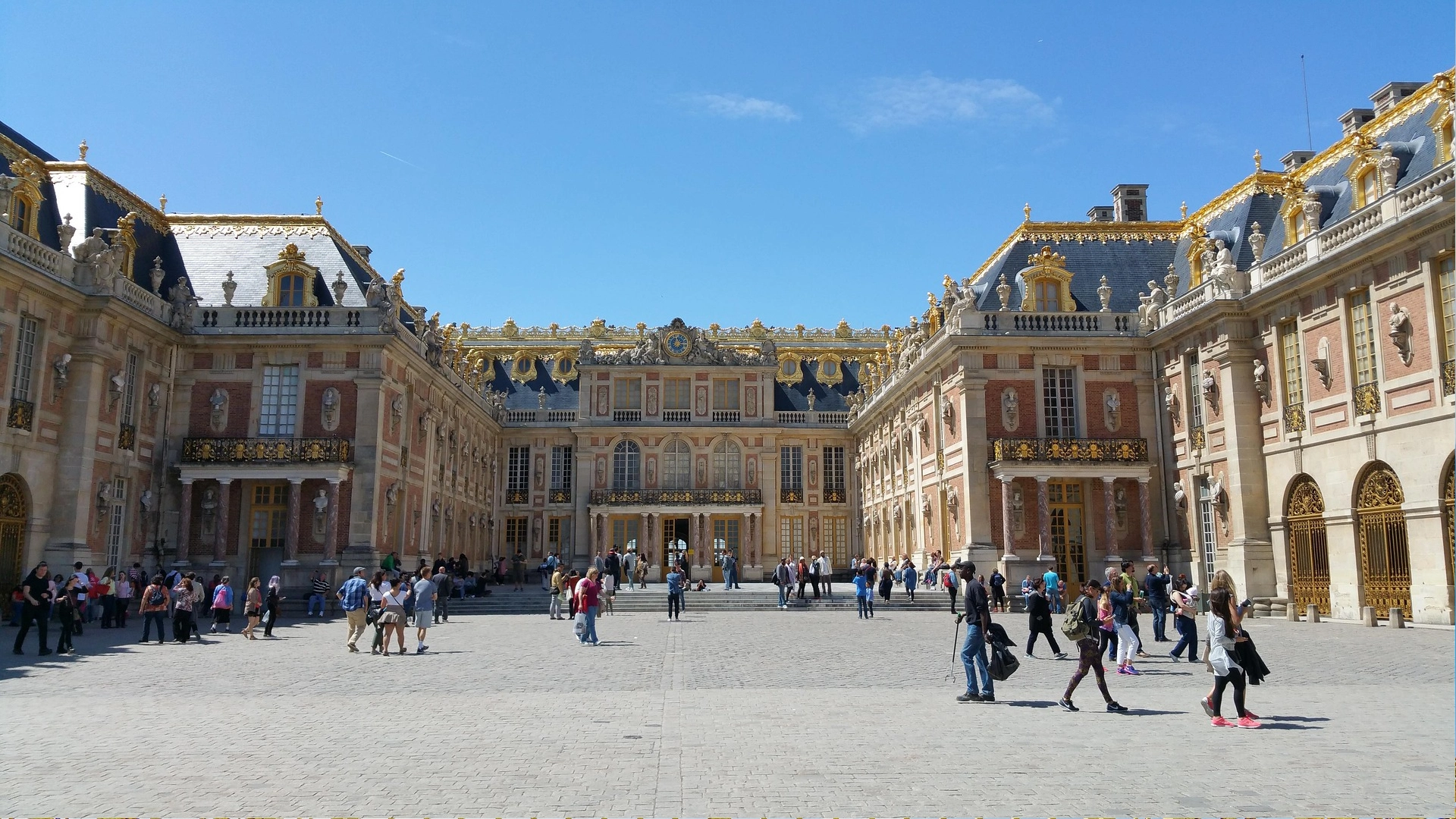
What strikes most about this transformation isn’t only its scale, but its coherence. Every wing, every façade, every courtyard aligns with a precise idea: expressing royal authority through symmetry, light, rhythm, and perspective. Under Hardouin-Mansart, this coherence becomes almost a signature. His sense of balance and proportion gives Versailles its clarity. Over time, the estate ceased to be a mere residence and became a total environment: royal home, administrative center, political stage, and a showcase of monarchical culture.
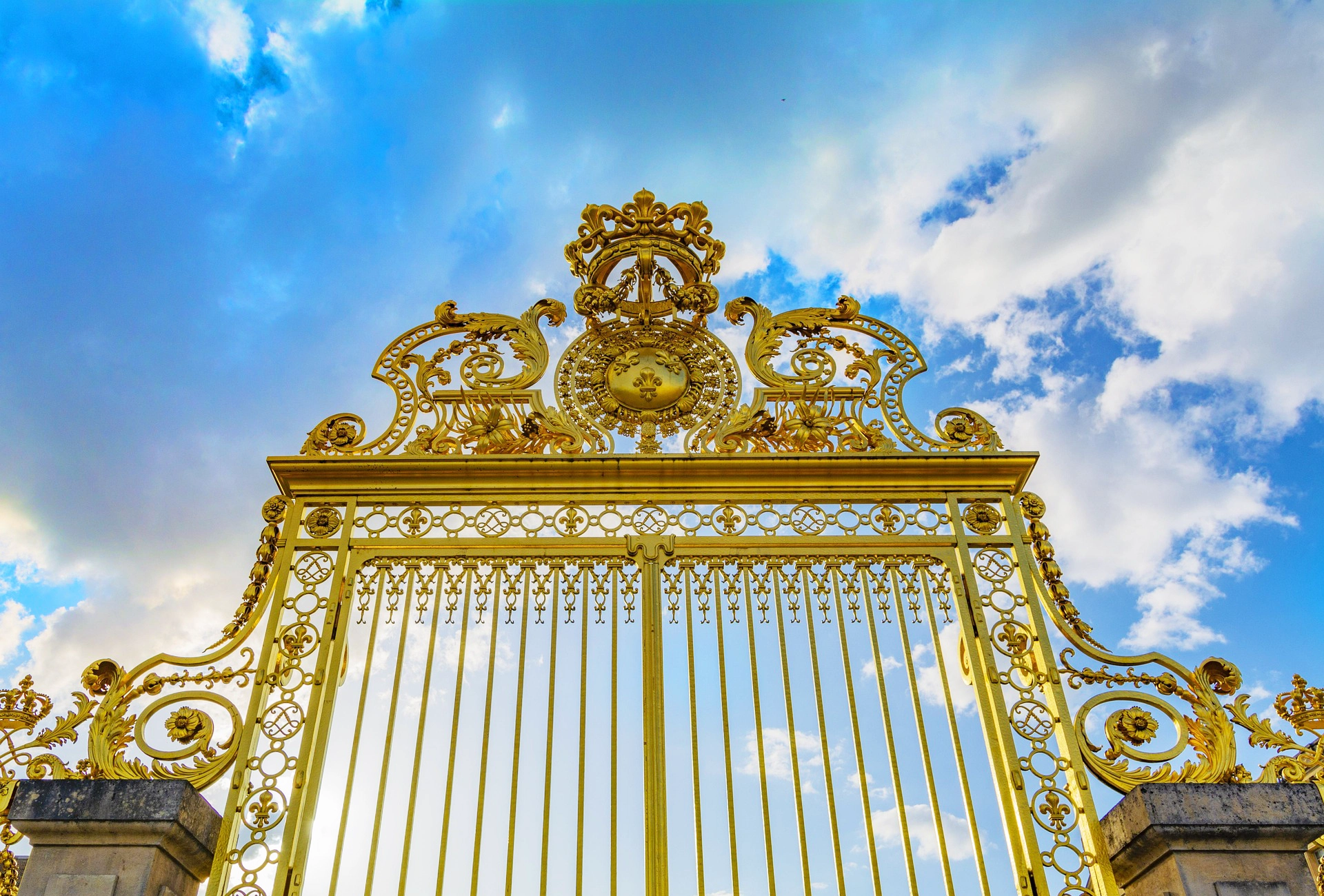
Within this carefully designed sequence, the golden gate plays an essential role. Installed in the 1680s, it marks the transition between the Court of Honor and the Royal Courtyard. Its function goes far beyond ornament: it structures the space and makes visitors feel, almost physically, that they are crossing into a realm where every detail carries the king’s imprint.
The Golden Gate: a spatial marker, a deliberate gesture
When Versailles reached its classical form under Louis XIV, architects needed to clarify the sequence of spaces leading to the heart of the palace. The Court of Honor remained open and welcoming. The Royal Courtyard, however, announced the sovereign’s inner sphere. And it was Jules Hardouin-Mansart — the chief orchestrator of Versailles’ major reorganization — who shaped the logic of how one moves through these spaces, guiding the eye and framing the approach to power. A threshold between the two courtyards became essential.
This is exactly what the golden gate provides. Installed in the 1680s, it materializes the boundary between an outer, accessible area and a strictly royal domain. Not a barrier in the literal sense, but a signal — a silent line of meaning that says: “You are entering the king’s domain.” The sun emblems, the fleur-de-lis, the balanced proportions all reflect the visual language of the reign, without excess yet with unmistakable authority.
Architecturally, its role is decisive. The gate creates a pause, a moment of balance in the long perspective. It helps the eye adjust from the broad expanse of the Court of Honor to the more concentrated space of the Royal Courtyard — a spatial clarity perfectly aligned with Hardouin-Mansart’s vision. Without it, the transition becomes vague. With it, the movement feels natural.
1772: dismantling a discreet but essential landmark
In 1772, the gate was dismantled. The reason lay in a major construction project: the building of the Gabriel Wing, designed to give the inner façade a more regular, symmetrical appearance consistent with the architectural tastes of the 18th century. To achieve this new alignment, the gate became an obstacle — it broke the perspective. Its removal was ordered.
The dismantling caused no scandal, but it profoundly altered the perception of the site. As the wrought-iron panels disappeared, the transition between the two courtyards lost its clarity. The Royal Courtyard no longer had a natural threshold. The perspective stretched, unanchored, almost drifting. Visitors moved from one courtyard to the next without sensing the shift in status. Something essential had vanished, even if few could name it.
For more than two centuries, this is how Versailles stood: still majestic, yet missing a key element of its architectural logic.
2005–2008: restoring a forgotten rhythm
In the early 21st century, during the Grand Versailles restoration program, the question naturally resurfaced: should the gate be restored? The goal wasn’t to add decoration, but to restore the clarity and symbolic coherence the palace had under Louis XIV.
Restoring it required extreme precision. This wasn’t about creating an approximation — the task was to recover the authentic 17th-century gate, with its original proportions, motifs, and joinery. Teams immersed themselves in archives, comparing drawings, engravings, and architectural plans to rebuild the design with complete accuracy.
In the workshops, the metalwork was revived using traditional techniques: heating, forging, adjusting by hand. The artisans weren’t seeking modern effects, but authenticity. Then came the gold leaf gilding, applied patiently, giving the surface depth without harsh shine.
When the gate was finally reinstalled, the equilibrium returned. The Court of Honor regained its role as the open threshold. The Royal Courtyard recovered its sense of controlled intimacy — a quiet signal that one was entering the king’s sphere.
Today, when visitors walk past the golden gate, they feel what people of the 17th century once sensed: they are crossing more than a passageway. They are entering a space where architecture speaks the language of power.
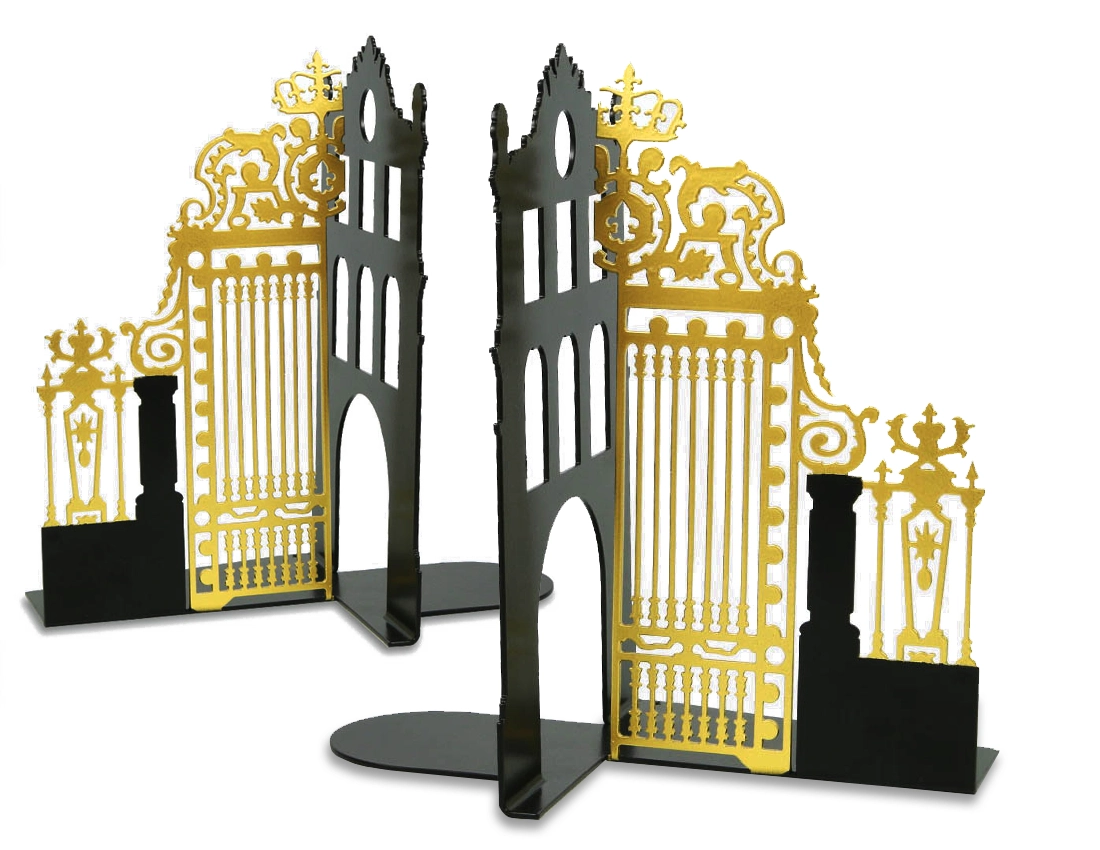
The “Golden Gate of Versailles” Bookend Set
Echoing the monument’s grandeur, the “Golden Gate of Versailles” bookend set brings, in a more intimate scale, the elegance and precision that define the palace’s iconic 17th-century gate. The fine lines, the ornamental rhythm, the play of light across the metal — all reflect the spirit of Versailles. Placed on a shelf or a desk, the set carries a quiet presence: a fragment of royal architecture reimagined in metal, designed to last and to showcase your favorite books. A piece where heritage, design, and craftsmanship meet.